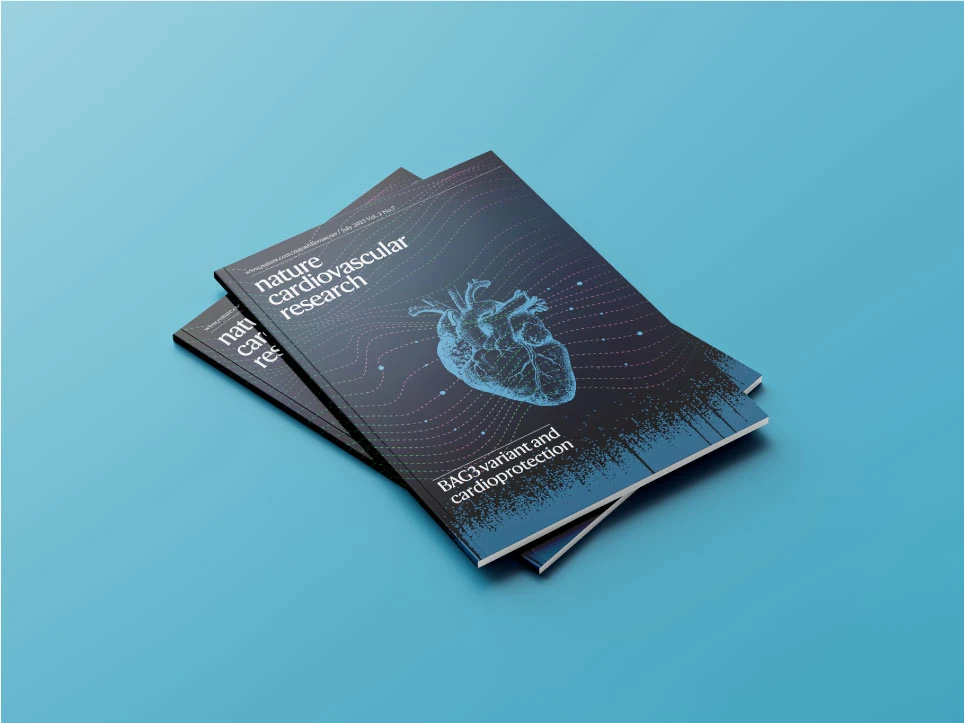
Nature Cardiovascular Research · Cover
Med & Biotech
Nature Cardiovascular Research — July 2023 Cover
- Year
- 2023
- Client
- Gladstone Institute. UCSF
- Discipline
- Cover illutration
Overview
Cover illustration for the July 2023 issue of Nature Cardiovascular Research (Vol. 2, No. 7), commissioned to visualize the landmark study on BAG3 variant and cardioprotection. Every visual element carries scientific meaning.
Nature Cardiovascular Research is a peer-reviewed journal published by the Nature Portfolio, covering the full spectrum of cardiovascular science. The July 2023 issue featured a letter by Perez-Bermejo, Judge, Conklin et al. (published 26 June 2023) on how a common BAG3 variant confers cardioprotection—a significant finding in the genetics of heart disease.
Challenge
Scientific journal covers operate under a specific constraint: the illustration must be visually arresting enough to stand as a cover image while remaining scientifically rigorous and faithful to the research it represents. It cannot be merely decorative—every element needs to earn its place by communicating something true about the science.
Approach
The composition is built around three scientifically grounded visual layers, each corresponding to a different dimension of the research:
The heart—a detailed anatomical illustration placed at the center, representing the organ under study and the cardioprotective effect of the BAG3 variant.
The dashed wave lines flowing horizontally across the background represent the myofibrils of heart muscle cells: the structural filaments where BAG3 molecules reside. The wave-like motion references both the rhythmic contraction of cardiac muscle and the undulating signal of an electrocardiogram. The multicolored dots traveling along them represent the BAG3 molecules themselves.
The Manhattan plot—the scattered dot pattern at the base of the image—replicates the structure of a Manhattan plot, the statistical visualization used in genome-wide association studies to identify significant genetic variants. Its presence grounds the image in the population genetics methodology at the heart of the research.
The result is an image that works on two levels simultaneously: as a striking piece of visual design and as a precise scientific diagram that researchers in the field will immediately recognize and understand.